Blog
What Should a Cybersecurity Marketing Dashboard Actually Show a CMO?
Article Summary
Most cybersecurity marketing dashboards are built for channel managers, not CMOs. A dashboard built for the C-suite strips out channel noise, connects activity to pipeline, and tells you in 60 seconds whether marketing is doing its job. Here's how to build one that does.
Key Takeaways:
- Marketing-sourced pipeline and pipeline velocity are the two most important metrics for executive visibility, not impressions, clicks, or MQL volume
- Leading indicators like MQL-to-SQL conversion rate and pipeline coverage ratio give you early warning before a miss shows up in revenue
- At least half the metrics on most cybersecurity marketing dashboards can be cut without losing any useful signal
Ask a cybersecurity marketing team to pull up their dashboard and you'll usually see the same thing: a wall of numbers. Impressions. Click-through rates. Email open rates. Form fills. Content downloads. MQL counts. Cost per lead.
It looks like rigor. It isn't.
A company with 50,000 LinkedIn followers and zero pipeline contribution is performing worse than a company with 2,000 followers and consistent inbound qualified leads. The same logic applies to dashboards. A dashboard that shows everything tells you nothing actionable.
For cybersecurity CMOs specifically, this is a real problem. Sales cycles in this market are long, buying committees are large, and the journey from first content download to closed deal can span six to eighteen months across dozens of touchpoints. The average B2B customer journey stretches around 192 days, with 60+ touchpoints and more than six stakeholders. Tracking that journey with last-click metrics or weekly MQL counts is like checking your blood pressure once a year and calling it a health plan.
The fix isn't a better reporting tool. It's a different philosophy about what a CMO actually needs to see.
What Executives Actually Care About
Let's be direct about what the question really is at the executive level. It's not "how did our webinar perform?" It's one of three things: Are we building enough pipeline to hit revenue targets? Is marketing spend working efficiently? Are we going to hit our number this quarter?
Everything else is interesting but not urgent.
Marketing-sourced pipeline is the single most important KPI in B2B marketing because it directly measures marketing's contribution to revenue. Every other metric, from MQL volume to email open rates, is a supporting data point.
In the cybersecurity space, this matters more than in most B2B categories. The deals are large, the sales cycles are long, and the board is paying attention to the pipeline coverage ratio because it's a leading indicator of whether the company will make its number. Research from Full Funnel found that 64.74% of B2B CMOs said they struggle to prove direct revenue and pipeline influence. That's not a measurement problem. That's a dashboard problem.
The metrics executives care about fall into three categories:
Pipeline creation. Marketing-sourced pipeline (deals where marketing sourced the first touch) and marketing-influenced pipeline (deals where marketing engaged the buying committee at any point). Both numbers matter. The first shows origination. The second shows how broad marketing's reach is across active deals. Marketing-sourced revenue shows how marketing creates opportunities. Marketing-influenced revenue reflects deals where marketing played a role during the sales process.
Cost efficiency. Customer acquisition cost (CAC) and the CAC payback period. Not cost per lead. Not cost per MQL. CAC payback period tells you how fast your acquisition investment returns to you through gross margin. It's the metric investors care about most and the metric that determines how fast you can scale.
Forecast reliability. Pipeline coverage ratio (total pipeline value vs. quarterly revenue target) and pipeline velocity (how fast deals are moving). These two together answer whether marketing has done its job building the foundation for this quarter and next.
What Belongs on One Page

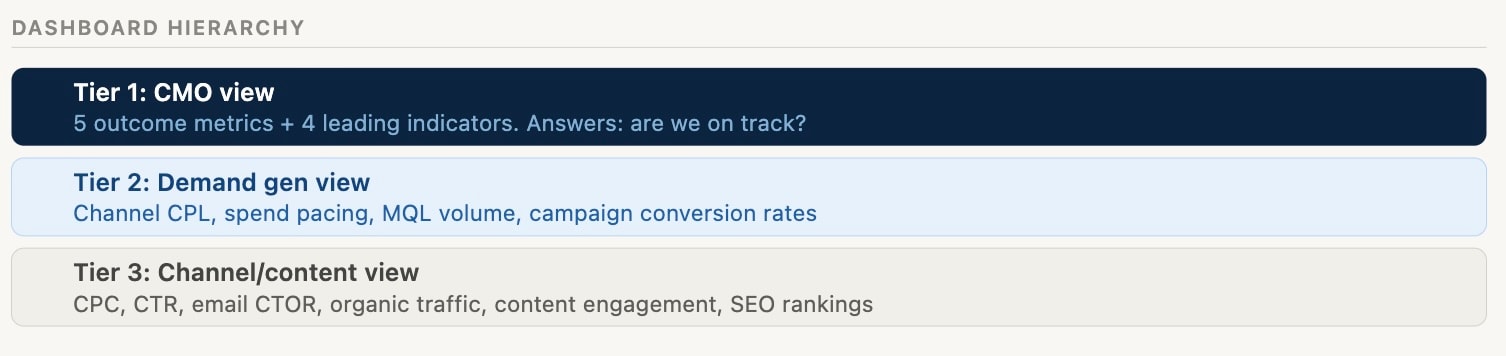
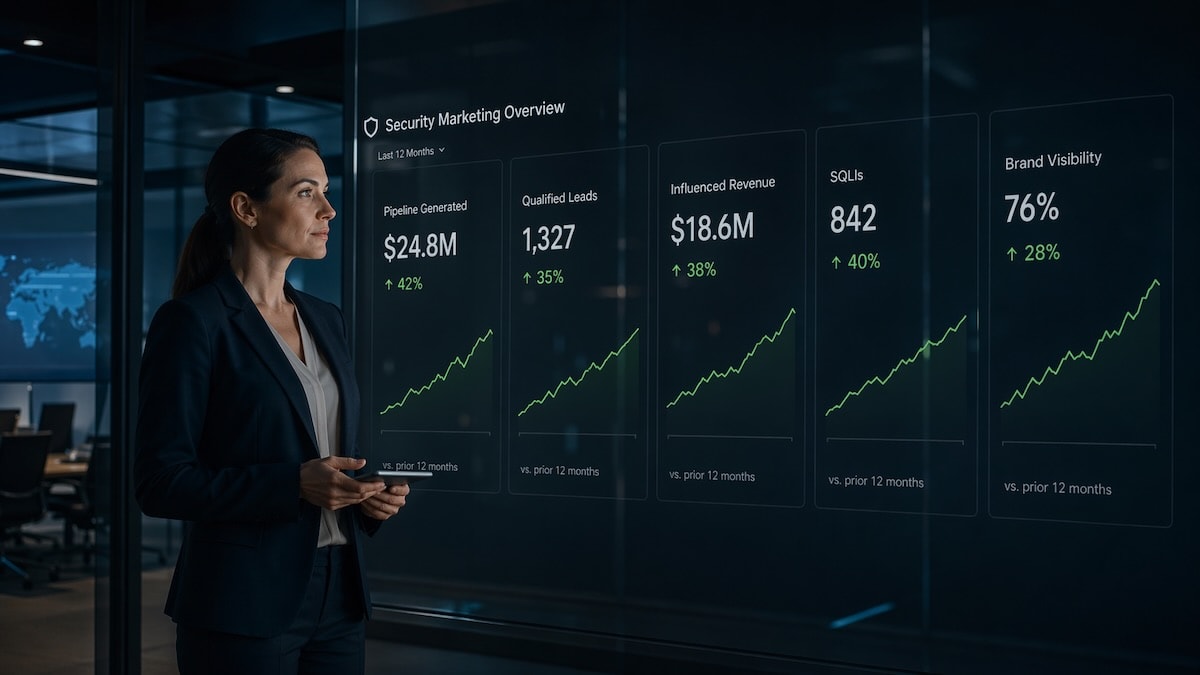
A CMO dashboard should answer five questions in under 60 seconds. Anything that can't fit that frame belongs on a secondary dashboard for the demand gen or channel manager.
The five questions:
- How much pipeline did marketing create this month and quarter?
- What percentage of total pipeline has marketing touched?
- What is our pipeline coverage ratio against target?
- What is our MQL-to-SQL conversion rate, and is it moving in the right direction?
- What is our blended CAC, and how is it trending?
That's it. Five data points. Three are pipeline-oriented. One is conversion quality. One is cost efficiency.
An executive dashboard should cover revenue impact, ROI, marketing contribution to pipeline, and CAC trends. A performance dashboard covering campaign managers should handle real-time spend pacing, CPL by channel, conversion rates, and creative performance separately.
Most cybersecurity marketing teams collapse both of those into a single view. The CMO ends up drowning in channel metrics they can't act on while the pipeline numbers they need are buried three clicks deep.
One useful structural rule: if a metric requires context to interpret, it doesn't belong on the CMO view. "LinkedIn CTR: 0.52%" means nothing without a benchmark, a trend line, and a comparison. "Marketing-sourced pipeline this quarter: $4.2M vs. $3.8M target" is immediately actionable.
This is also where the MQL debate is worth addressing directly. The MQL was invented to give marketing teams a metric they could control. It worked beautifully for a decade. And it has been systematically destroying alignment between marketing and sales ever since. In cybersecurity specifically, where content downloads are a routine part of ongoing practitioner research rather than active buying signals, MQL volume is a particularly unreliable proxy for pipeline health. The number to show a CMO isn't MQLs generated. It's MQL-to-SQL conversion rate, which tells you whether the MQLs you're generating are actually qualifying.
Leading Indicators: What to Watch Before the Miss

The hardest part of the CMO dashboard conversation isn't identifying the right outcome metrics. It's identifying the signals that predict those outcomes 60 to 90 days in advance.
In a cybersecurity sales cycle with a 6-to-9 month average, by the time a pipeline problem shows up in closed-won data, you've already missed two quarters. You need metrics that fire earlier.
Leading indicators predict outcomes (coverage, conversion intent, cycle time). Lagging indicators confirm results (pipeline, bookings, CAC, NRR). You need both to steer weekly moves and validate quarterly performance.
The most useful leading indicators for a cybersecurity CMO dashboard:
MQL-to-SQL conversion rate. This is the single best early signal of whether your lead generation quality is trending up or down. Organizations with weekly pipeline velocity tracking achieve 34% revenue growth versus 11% for those with irregular tracking. A healthy B2B benchmark sits between 20% and 30%. The floor is 10%. Below that, the issue is almost certainly misalignment between marketing and sales on lead qualification criteria, not campaign performance.

If that number drops two months in a row, it means either your lead quality is degrading or sales is rejecting leads that should qualify. Either way, you have a problem that won't show up in revenue for another quarter. The dashboard should surface it now.
Pipeline coverage ratio. Total value of open opportunities divided by quarterly revenue target. A 3x coverage ratio is generally considered the minimum for predictable forecasting. If it drops below 2.5x, marketing needs to accelerate pipeline creation immediately. This is a number that should be visible to the CMO every week, not every month.
Pipeline velocity. Pipeline velocity is a leading indicator of future revenue. While trailing indicators like quarterly sales tell you what happened in the past, velocity helps you forecast what's likely to happen next. The formula is: (Number of qualified opportunities × Average deal size × Win rate) ÷ Average sales cycle length. A declining velocity means deals are taking longer, getting smaller, or closing at a lower rate. All three are early warning signs.

SQL volume trend. Month-over-month growth in net new SQLs. If SQL volume is growing faster than win rate is declining, the program is working. If both are moving in the wrong direction at once, that's an urgent signal.
These four leading indicators can sit on the CMO dashboard as trend lines alongside the five primary outcome metrics. Together, they create what amounts to a marketing weather forecast: not just what happened, but what's likely to happen next.
Metrics to Cut

This is the section most dashboard discussions skip because it requires admitting that a significant portion of what gets reported every month isn't driving any decisions.
Here are the metrics that appear most frequently on cybersecurity marketing dashboards and that a CMO can safely remove from their primary view:
Total website traffic. Traffic divorced from conversion data tells you almost nothing useful. A highly targeted post driving 400 visits with a 12% conversion rate to contact form submissions is objectively more valuable than a post driving 10,000 visits with no conversions. Replace it with traffic-to-lead conversion rate by channel and content category.
Email open rates. Since Apple's Mail Privacy Protection changes in 2021, email open rates have been substantially inflated and are no longer reliable. Litmus's 2025 State of Email Report confirms open rates must be interpreted with caution and should not be used as a primary performance metric. Use click-to-open rate and reply rate instead, and keep those on the channel manager dashboard, not the CMO view.
Social media follower counts and impressions. These are brand awareness proxies at best. In the cybersecurity sector, where buyers are skeptical of vendor messaging and do most of their research independently, impression volume has a weak relationship with pipeline. Track engagement from target accounts via ABM intent data instead.
Raw MQL volume. As discussed, this number optimizes for quantity over quality and creates misaligned incentives. The CMO should see MQL-to-SQL conversion rate, not MQL count.
Content downloads without follow-on engagement data. A whitepaper download is a micro-signal. It only becomes meaningful in context: did that account show up in other intent data within 30 days? Did the contact progress to a product demo? Without that context, download counts are noise.
Cost per click and cost per lead. These are channel-level efficiency metrics that belong on the paid media manager's dashboard. What the CMO needs is blended CAC and cost per SQL, which show efficiency at the point where marketing investment actually matters.
The Attribution Problem Nobody Wants to Talk About
One reason cybersecurity marketing dashboards get cluttered is that attribution is genuinely hard, and teams compensate by tracking everything and hoping something will stick.
The reality is that no attribution model gives you a complete picture of a 9-month deal with 12 stakeholders and 40+ touchpoints. First-touch misses everything that happened in the middle. Last-touch gives all the credit to the form fill and none to the six webinars and three analyst reports the buying committee consumed beforehand.
The combination of direct attribution and influence data gives leadership a more complete and defensible picture of marketing's contribution. Last-click attribution credits 100% of a deal's marketing contribution to the final trackable touchpoint before conversion. In B2B, this is usually a form fill, a demo request, or a contact page submission. The problem is structural. In a typical 12-month enterprise deal, there may be 30 to 50 marketing touchpoints before that final form fill.
A practical approach for most cybersecurity marketing teams is a blended attribution model: multi-touch attribution for tracked channel contribution, plus an influence overlay that captures dark funnel signals like G2 intent data, thought leadership engagement, and analyst mention activity.
The CMO doesn't need to see the underlying attribution model. But they do need the dashboard to reflect marketing's total contribution to pipeline, not just the last-click share. Present it as two numbers: marketing-sourced pipeline and marketing-influenced pipeline. One shows origination. The other shows reach.
Putting It Together
A CMO dashboard that actually works isn't complicated. It's disciplined.
Five primary metrics on one screen: marketing-sourced pipeline, marketing-influenced pipeline, pipeline coverage ratio, blended CAC, and quarter-to-date performance vs. target. Four leading indicators underneath: MQL-to-SQL conversion rate, net new SQL trend, pipeline velocity, and pipeline coverage trend.
Everything else, channel performance, content analytics, campaign-level CPL, email metrics, belongs on secondary dashboards that the CMO can drill into when a primary metric triggers a question.
The goal is to streamline your measurement strategy and focus on a handful of north star metrics that directly connect marketing activities with business outcomes. That's a deceptively difficult thing to build because it requires making hard choices about what not to show.
But a dashboard that answers five questions clearly and fast is worth a hundred dashboards that show everything and answer nothing.